
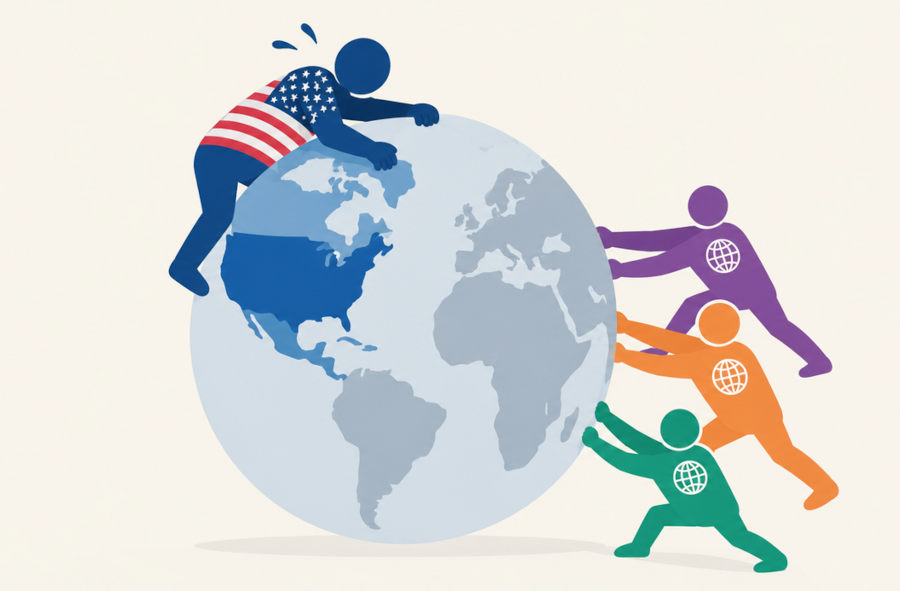
Bots traffic at 49.6%.
The boundaries of the American web are shifting faster than expected.
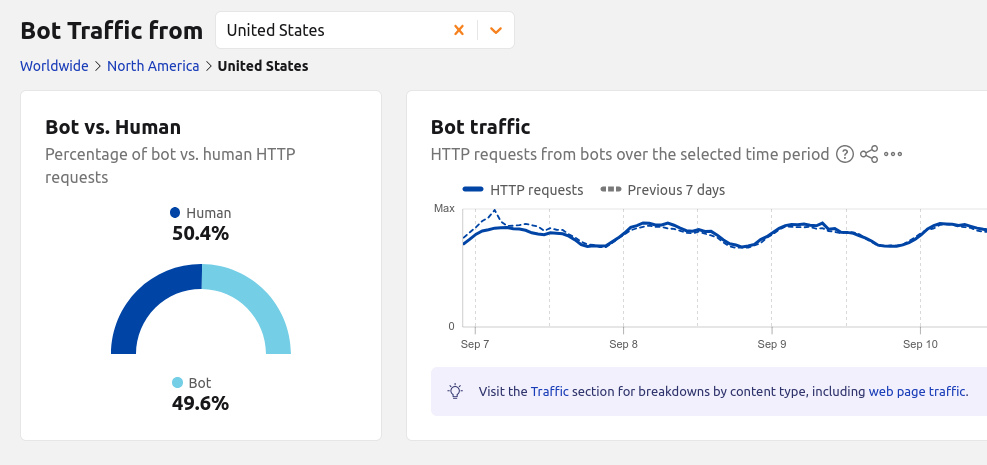
According to real-time data from Cloudflare Radar, human traffic in the United States currently holds a razor-thin 50.4% majority of total HTTP requests, while automated bots lag by less than a single percentage point at 49.6%. As automated agents, search crawlers, and data-harvesting scrapers scale up across domestic networks, the United States stands directly on the brink of becoming a majority-bot digital ecosystem.
If you feel like the American internet is getting a little less "human" lately, you're not imagining things—we are right at the tipping point.
According to real-time US web traffic tracking from Cloudflare Radar, human users in the United States are now clinging to a paper-thin majority. Human visitors account for 50.4% of all US HTTP requests, while automated bots follow right on their heels at 49.6%.
We are separated by less than a single percentage point from a US web where non-human code makes up the majority of all digital activity.
The Digital Tug-of-War in the US: 50.4% vs. 49.6%
For years, human browsing dominated US web activity by a comfortable margin. But over the past year, the massive expansion of automated tools across American servers has narrowed the gap to a near 50-50 split.
While many associate "bots" with malicious hackers or spam accounts, today’s 49.6% slice of US traffic is driven largely by a new generation of automated systems:
- AI Models & Scrapers: Large language models and search tools constantly sweep public US sites to feed training datasets and index live web pages.
- Autonomous AI Agents: Shopping assistants, price aggregators, and research agents acting on behalf of real users.
- Infrastructure & Monitoring: Server checks, uptime trackers, and API integrations running thousands of times a second across US networks.
What This Means for Web Owners & Marketers
As human US traffic sits at just 50.4%, website owners targeting American audiences need to rethink how they manage their digital footprint:
- Half Your Traffic Might Not Be a Buyer: If nearly half of your incoming US requests are non-human, standard page-view metrics can easily distort your real audience size and conversion performance.
- Server Costs Are Being Split: Bandwidth costs are no longer just supporting human visitors; almost half of your US server load may be coming from scripts and crawlers.
- Designing for Two Audiences: Modern web optimization is no longer just about human UX. Sites now have to optimize for human readers while ensuring content is structured cleanly for the 49.6% of traffic made up of automated agents and indexers.
The US web is currently balanced right on the edge. While human users in the United States still retain the majority at 50.4%, the steady rise of automated agents means American digital traffic may soon step across the threshold into a bot-dominated era.
Recent data from Cloudflare Radar reveals that human users in the United States hold a narrow 50.4% majority of total HTTP traffic, with automated bot activity following right behind at 49.6%. This near 50-50 split highlights how rapidly software automation has expanded across US network infrastructure, driven primarily by continuous data harvesting for large language models, autonomous AI agents retrieving real-time information, and routine infrastructure operations. Consequently, website owners face immediate operational challenges as traditional pageview analytics become increasingly distorted, server bandwidth is split between human consumers and autonomous software, and modern web design must adapt to serve both human end-users and non-human indexers.
Looking Ahead: The Agentic Web and Future Outlook
As automated traffic pushes toward a permanent majority on American servers, the digital landscape will fundamentally shift away from traditional human-centered browsing patterns. The era of providing free, unstructured web data to non-human traffic is rapidly drawing to a close, primarily because serving bots incurs significant bandwidth costs without delivering ad impressions or standard e-commerce conversions. In response, site owners and networks will increasingly implement machine-native access controls, adoption of pay-to-crawl micropayments, and cryptographic bot authentication, creating a dual-tier internet where software must pay dedicated tolls to access high-quality data.
At the same time, digital marketing and web design will evolve from standard Search Engine Optimization toward Agentic Interface Optimization. Rather than structuring websites to rank visually on a screen for human eyes, developers will prioritize machine-readable data payloads, clean APIs, and structured schemas that allow AI shopping assistants and personal bots to parse and execute transactions directly. Ultimately, traditional metrics like pageviews, bounce rates, and session durations will become obsolete, forcing organizations to adopt identity-verified analytics that separate genuine human engagement from the vast, background noise of the automated web.
Looking Ahead: The Agentic Web and Future Outlook
As automated traffic pushes toward a permanent majority on American servers, the digital landscape will fundamentally shift away from traditional human-centered browsing patterns. The era of providing free, unstructured web data to non-human traffic is rapidly drawing to a close, primarily because serving bots incurs significant bandwidth costs without delivering ad impressions or standard e-commerce conversions. In response, site owners and networks will increasingly implement machine-native access controls, adoption of pay-to-crawl micropayments, and cryptographic bot authentication, creating a dual-tier internet where software must pay dedicated tolls to access high-quality data.
At the same time, digital marketing and web design will evolve from standard Search Engine Optimization toward Agentic Interface Optimization. Rather than structuring websites to rank visually on a screen for human eyes, developers will prioritize machine-readable data payloads, clean APIs, and structured schemas that allow AI shopping assistants and personal bots to parse and execute transactions directly. Ultimately, traditional metrics like pageviews, bounce rates, and session durations will become obsolete, forcing organizations to adopt identity-verified analytics that separate genuine human engagement from the vast, background noise of the automated web.