
Introduction
An XML sitemap is one of the most practical technical SEO tools available. It gives search engines a clear, structured list of the pages you want them to discover and consider for indexing. While strong internal linking remains essential, a well-built sitemap improves crawl efficiency, especially on larger, newer, or more complex sites. This guide covers what an XML sitemap is, how it works, how to create and implement one, and the best practices that matter most today.
What Is an XML Sitemap?
An XML sitemap (commonly named sitemap.xml) is a machine-readable file written in Extensible Markup Language. It lists the important URLs on your website and can include optional metadata such as the date a page was last modified.
Search engines like Google, Bing, and others read this file to understand which pages exist, which ones you consider important, and (when the data is accurate) when content has changed. The official protocol is maintained at sitemaps.org and has been jointly supported by major search engines since 2006.
A sitemap is not a guarantee of indexing. Search engines still decide what to crawl and index based on many signals. It is, however, a strong discovery and prioritization aid. It also differs from an HTML sitemap, which is designed primarily for human visitors.
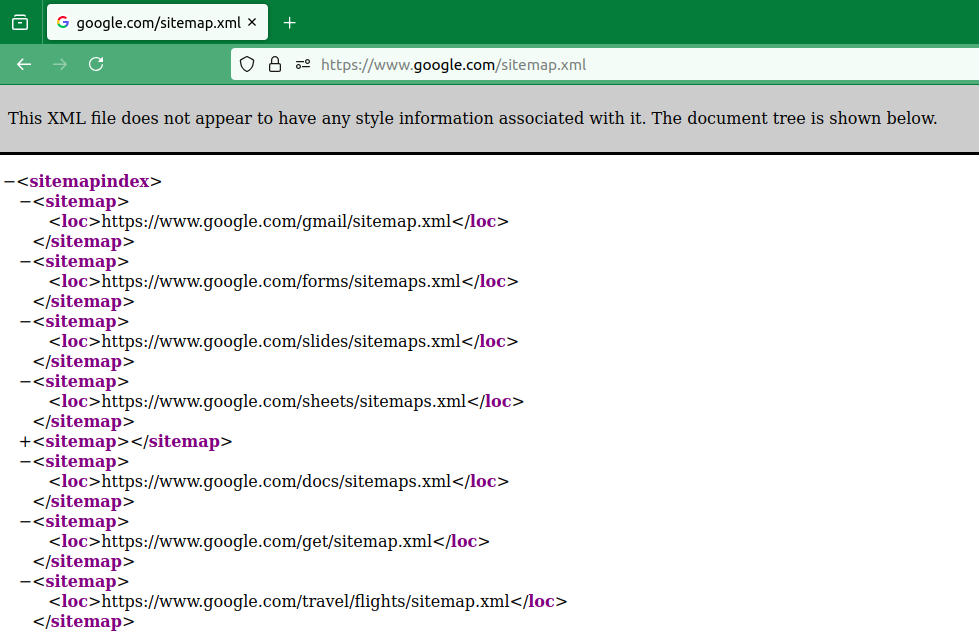
You will often find a site’s sitemap at https://example.com/sitemap.xml or https://example.com/sitemap_index.xml.
Why XML Sitemaps Matter for SEO
Search engines discover most pages by following links. On small, well-linked sites this works well. On large sites, sites with deep or isolated pages, new sites with limited external links, or sites that publish content frequently, discovery can be incomplete or slow.
An XML sitemap helps by:
- Providing a direct inventory of the URLs you want crawled.
- Signaling freshness through accurate
<lastmod>dates. - Supporting specialized content (images, video, news) via extensions.
- Giving you visibility in tools like Google Search Console, where you can compare submitted vs. indexed URLs and diagnose issues.
Google has stated that a sitemap can improve crawling of larger or more complex sites even when internal linking is solid. It is low-effort insurance that costs almost nothing and can surface crawl or indexation problems early.
Anatomy of an XML Sitemap
A basic XML sitemap follows this structure:
<urlset xmlns="http://www.sitemaps.org/schemas/sitemap/0.9">
<url>
<loc>https://www.example.com/</loc>
<lastmod>2026-08-15</lastmod>
</url>
<url>
<loc>https://www.example.com/about/</loc>
<lastmod>2026-07-20</lastmod>
</url>
</urlset>
Basic XML sitemap follows this structure.
Key elements:
<?xml version="1.0" encoding="UTF-8"?> — Required declaration. The file must be UTF-8 encoded.<urlset> — Root element with the official namespace.<url> — Container for each individual page.<loc> — Required. The full absolute URL (including https://).<lastmod> — Strongly recommended. Last modification date in W3C Datetime format (e.g., 2026-08-15 or with time). Google uses this when the date is consistently accurate.<changefreq> and <priority> — Optional and largely ignored by Google. Other engines may give them slight weight, but they are not reliable signals.
Special characters in URLs must be properly escaped (e.g., & becomes &).
Best Practices for XML Sitemaps
Follow these guidelines for maximum effectiveness:
- Include only indexable, canonical URLs that return HTTP 200. Exclude redirects, 404/5xx pages,
noindexpages,robots.txt-blocked URLs, thin or duplicate content, and non-canonical variants. - Use absolute URLs with the preferred protocol and host (
https,wwwornon-www). - Keep
<lastmod>accurate and consistent with actual page changes. Inaccurate dates reduce trust in the signal. - Generate the sitemap dynamically whenever possible.
- Stay within the 50,000 URL / 50 MB limits; use an index file when needed.
- Reference the sitemap (or index) in
robots.txt. - Submit and monitor in Google Search Console and Bing Webmaster Tools (Alternative).
- Update the sitemap promptly when content changes significantly.
- For specialized content, use the appropriate extensions (image, video, news) rather than forcing everything into a basic sitemap.
- Ensure the file is valid
XMLandUTF-8encoded.
A clean, selective sitemap is far more valuable than an exhaustive one that includes every possible URL.
Common Mistakes to Avoid
- Listing non-indexable or low-value pages (wastes crawl budget and sends mixed signals).
- Including non-canonical or redirected URLs.
- Using relative URLs or incorrect protocols.
- Letting the sitemap grow stale.
- Relying on
<priority>and<changefreq>as meaningful ranking signals. - Exceeding size limits without using an index.
- Blocking the sitemap itself in
robots.txt.
Summary and Key Takeaways
An XML sitemap is a structured list of the URLs you want search engines to know about. It improves discovery and crawl prioritization without replacing good internal linking or high-quality content.
Core actions that deliver results:
- Generate a clean, dynamic sitemap containing only canonical, indexable 200-status URLs.
- Include accurate
<lastmod>dates. - Host it accessibly, declare it in
robots.txt, and submit it to major search engines. - Split large sites with a sitemap index.
- Monitor performance in Search Console (Alternatives) and keep the file current.
Implemented correctly, a sitemap is a low-maintenance technical foundation that helps search engines find and understand your important pages more efficiently. For most websites it is a recommended practice; for large or frequently updated sites it is close to essential. Keep it accurate and selective, and it will quietly support better crawl coverage and indexation over time.